Assessment and progress
Special school assessment and progress tracking
Understand progress from pre-formal through formal learning without reducing a pupil’s journey to a single upward line. Keep frameworks, everyday evidence and professional judgement connected.
The practice problem
Progress is rarely one number moving in one direction
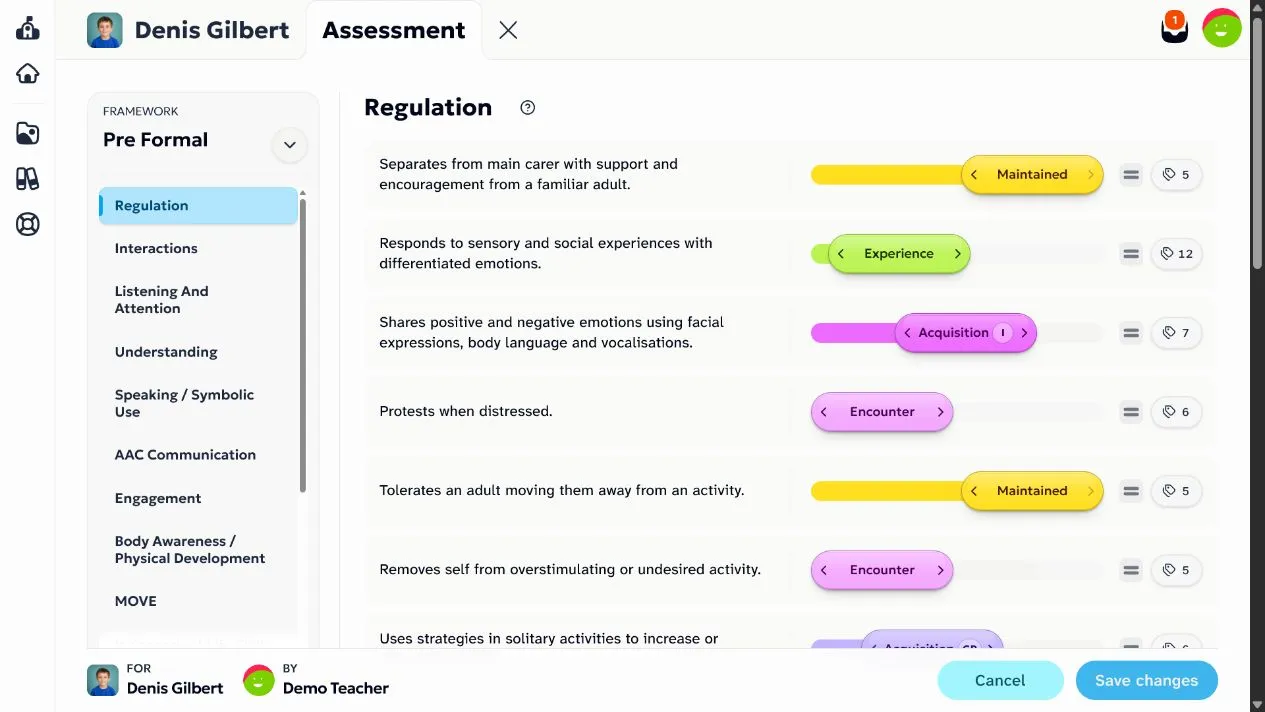
Pupils may demonstrate change through increased independence, a different context, less prompting, greater fluency or maintaining learning after a break. Those changes can be important even when a conventional level appears unchanged.
Assessment is therefore more than recording a score. Schools need a coherent relationship between curriculum, frameworks, observations, selected evidence, professional judgement and review.
A connected workflow
Keep the thread visible from one decision to the next
- 1
Curriculum
Begin with what the pupil is learning and why.
- 2
Observation
Notice what happened, including context and support.
- 3
Evidence
Select information that genuinely supports interpretation.
- 4
Assessment
Apply the school’s framework and professional judgement.
- 5
Review
Look across time, settings and people before deciding what changes.
What good practice can look like
Use frameworks to support a richer understanding
The right approach depends on a school’s curriculum and pupils. Strong practice can combine different frameworks while retaining shared expectations about evidence, language and moderation.
Keep curriculum and assessment distinct
An assessment framework can help staff interpret learning, but should not quietly become the whole curriculum or narrow what pupils experience.
Recognise more than upward movement
Generalisation, independence, fluency, maintenance and re-engagement can reveal meaningful change without a pupil moving to a new level.
Use qualifiers deliberately
Agree what terms mean in practice, test whether staff apply them consistently and keep the contextual evidence behind each judgement available.
Moderate differences, not just scores
A useful moderation conversation explores why judgements differ and records the reasoning behind the final view rather than forcing artificial uniformity.
Product scope
What Voyage supports
Included
- Support pre-formal through formal learning using built-in and school-configured frameworks.
- Record progress with qualifiers configured around the school’s approach.
- Use assessment-matrix and record-coverage views to understand gathered evidence.
- Support moderation comments and preserve a record of discussion.
Current scope
- Voyage does not prescribe one universally correct framework.
- It does not treat evidence volume as a proxy for learning.
- Voyage does not make automated assessment decisions about pupils.
Continue through the library
Related guidance and product detail
Connected pillar
Learning records and evidence for SEND
See how an event becomes a useful record and supports assessment over time.
Read this nextPractice library
Assessment and progress resources
Explore framework-neutral guidance on assessment, evidence and progress.
Read this nextProduct detail
What Voyage supports
Explore the capabilities available within a supported school implementation.
Read this nextExplore Voyage with us
Bring us the real way your school works.
We can follow a pupil journey from planning through everyday evidence, professional judgement and review—and be clear about what is available now.